|
|
Close Help | ||||||||||||||

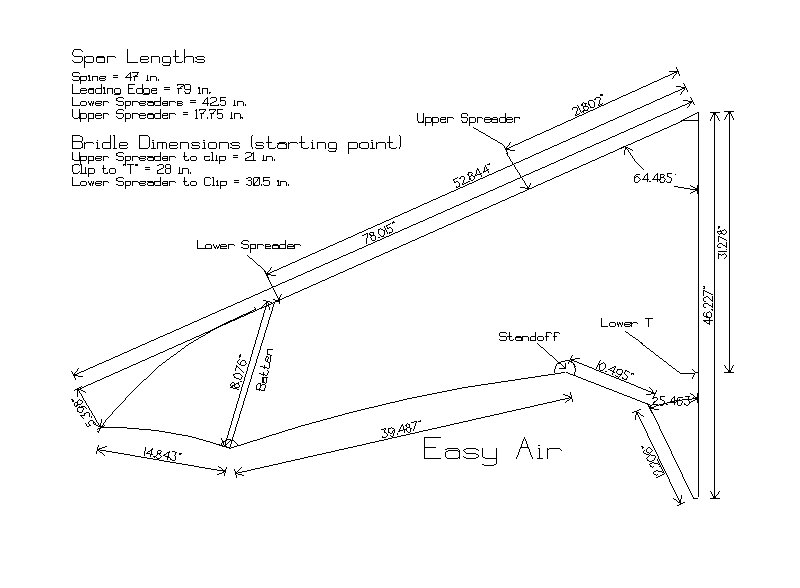
Now that I have settled on most of the basic stuff it is time to lay out the pattern. For a pattern I use taped together poster cardboard. In the upper right hand corner lay out an angle of 109/2 = 54.5 degrees. Along this angle extend a line to 80 inches. Next lay out the spine length. It is a simple exercise in trigonometry to determine that the spine would be 46.456 inches if it were to touch the ground simultaneously with the tips. But since we want the kite to rest on the wing tips we will shorten the spine to 46 inches. Let us now turn our attention to the wing tip. I prefer to curve the sail from the lower spreader attachment to the tip. This causes a slight bend in the leading edge and thus provides tension on the trailing edge to keep it from fluttering. It also provides a wrinkle in the sail just behind the leading edge that under aero loading blows up into a nice camber for the wing tip portion of the sail. This makes the tip more efficient for its size than it would be if everything was straight and no wrinkle occured.
But before we can lay this out we need to decide where the lower spreader goes. Normally I put the lower spreader somewhere between 65% and 70% down the leading edge. On this kite I selected 66%. This was because I didn't want the CG. to be too far aft and to trade off some increased stress in the leading edge for a little decreased stress in the longer than normal lower spreader spars. A second prototype of this design might try moving the spreader even farther up the leading edge. I don't believe one can calculate the optimum position that makes the proper trade off in relative stress in the spars and best CG. location, one just has to experiment with intelligent choices based on an understanding of what you want to accomplish.
For the wing tip design I chose to make the winglet the same size as the "Tip Turn" (see the first design of the month). The reason is that the tip on the smaller "Tip Turn" provided lots of twist, more than was required, so on this larger kite a tip of the same size as the smaller kite should be either closer to optimum or we will learn which way to go on the next kite. It isn't difficult to increase the area if required. One thought is to sew an extension to the inboard side of the wing tip and use a monofilament cheater line to hold the extensions taught. This will not only increase the winglet size but will prevent the bridle lines from becoming entangled with the kite frame components. By controlling the tension in the cheater line you have some additional control over the amount of twist at the wing tip. This technique is probably worthwhile doing even if the winglet does not need to be increased in size. The line can just be secured to the tip batten end, the spine tip, and the other batten end.
The location of the upper spreader is reasonably arbitrary, one could adjust its position to change the CG. I chose to make it at around 28% of the leading edge and I recommend connecting it to the spine with a small vinyl with holes drilled at right angles, much the same as the lower "T" fitting. If the kite does not glide well then both this spreader as well as the lower one can be moved forward. The upper spreader can be moved more without such a great effect on the structural strength of the kite frame.
The trailing edge of the sail was chosen with asthetics in mind. I wanted the kite to look good, at least to me. The long section between the standoff and the wing tip batten is cut in a concave arc so that it will be easier to keep taught. The two remaining straight line segments could just as well be a continuous curve, the only priority is that they be kept under tension to eliminate trailing edge flutter.
Well, here you have it: Easyair. If there are any comments or questions please e-mail me, lord@techline.com and I will try to address them. Those that provide additional insight into the particular design or the design process will be added to this section. I hope this information proves useful to some of you kite builders out there on the net.
RETURN to the LORD Main Page